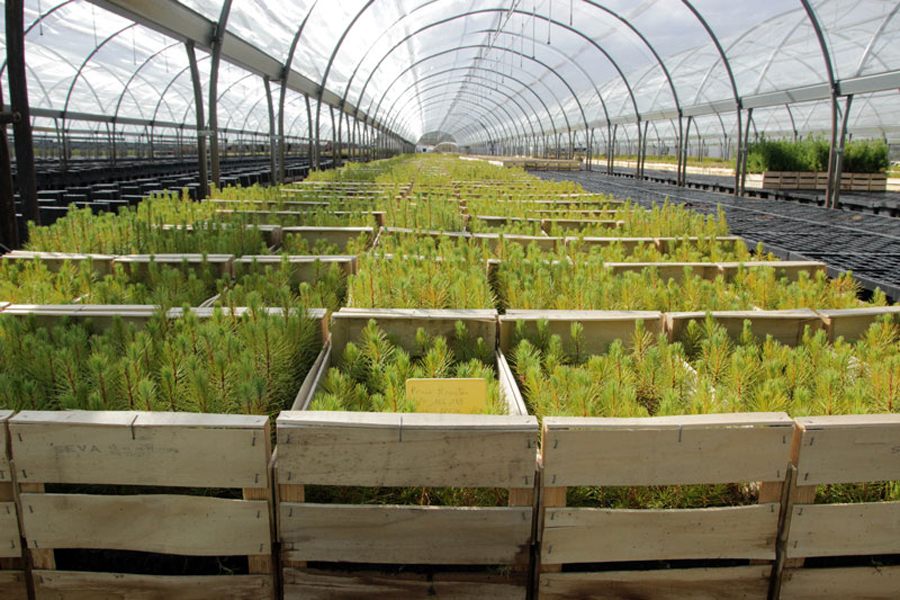
Afforestation and reforestation projects rely on the right planting material—known technically as forest reproductive material (FRM), which includes seedlings, seeds and vegetative propagules. In the EU, the production and trade of FRM are tightly regulated. This is because tree populations are highly adapted to their local environments, and using poorly matched material can reduce wood quality or, in the worst case, lead to large-scale plantation failure. Since such adaptation cannot be assessed simply by looking at a young plant, legislation ensures that all FRM is accurately labelled, traceable and suitable for its intended site.
Forest nurseries—unlike ornamental plant producers—must therefore comply with extensive documentation requirements and strict controls. They occupy a central but challenging position in the wider effort to adapt Europe’s forests to climate change.
Climate change, biodiversity loss and the need for billions of trees
European forests are increasingly threatened by climate extremes such as storms, drought and intense rainfall. Climate models predict major shifts in species distributions over the coming decades. On top of this, invasive pests and pathogens are further destabilising forest ecosystems. To safeguard forests, strategies now include assisted migration: the deliberate relocation of tree species or populations to areas where future conditions are expected to be more suitable. The EU has also committed to planting 3 billion additional trees by 2030 as part of its climate mitigation and biodiversity objectives. Meeting these ambitions depends on one fundamental question: Is the necessary high-quality FRM available when and where it is needed?

How OptFORESTS is examining Europe’s forest reproductive material supply system
The OptFORESTS project investigates exactly this issue. Afforestation, reforestation and assisted migration all rely on a steady, well-coordinated supply of high-quality FRM adapted to local or future site conditions. Early discussions with stakeholders indicated that many nurseries in Europe are facing difficulties, but a systematic, Europe-wide assessment was missing.
Key questions include:
• How many forest nurseries operate in Europe, and who owns them?
• What is their production capacity, and how is it distributed across regions?
• How can nurseries cooperate more effectively—for example, by exchanging surplus plants rather than discarding them?
• What barriers prevent nurseries from expanding and operating sustainably?
To answer these questions, OptFORESTS draws on the strong network of FRM experts across Europe, including the EUFORGEN network, which has coordinated forest genetic resource conservation for three decades. Data were collected through:
• national reports by FRM authorities,
• an online survey for forest nurseries (translated into 26 languages and distributed in 30 countries),
• a survey for seed traders, and
• 25 semi-structured interviews with nursery managers, providing crucial insights into operational challenges.

Uneven production capacity — and shared challenges across Europe
Our analysis reveals that the European forest nursery sector is extremely heterogeneous. Some countries rely heavily on private nurseries, others on public ones. In total, Europe currently produces roughly 3 billion seedlings per year. But regional imbalances are striking:
• Northern and Central Europe account for almost 85% of production.
• South-Western Europe (13%) and Eastern Europe (3%) produce much less.
In Central Europe, the sector is undergoing consolidation, with fewer but larger nurseries dominating the market. Meanwhile, nurseries in South-Western and Eastern Europe will need to scale up significantly to meet growing demand.
Across Europe, nurseries report similar pressures. These include high production risks due to long cultivation cycles and uncertain sales; difficulties in securing high-quality seed (a problem exacerbated by climate impacts on seed production); challenges in staff recruitment; volatile or insufficient subsidies; and rising costs for energy, staff and materials. Such pressures reduce operational stability and make long-term planning difficult. Although collaboration within countries is common, cross-border cooperation remains limited and should be strengthened.
Towards a sustainable supply of forest reproductive material
A reliable supply of adapted FRM is fundamental to Europe’s forest resilience. OptFORESTS aims to support policymakers and forest managers by identifying bottlenecks and proposing practical solutions. These may include targeted subsidy schemes or incentives that reduce production risks for nurseries.
Moreover, long-term delivery contracts between forest managers and nurseries could enhance economic security for both sides, ensuring predictable demand and stable supply.
In the next phase, OptFORESTS will model future FRM needs under various climate and management scenarios. Based on these projections, we will develop strategic recommendations for building a resilient FRM supply system across Europe. These insights will help stakeholders—from seed suppliers to nursery managers to forest owners—make informed decisions about seed collection, production planning and long-term investment.
Ensuring that Europe has enough high-quality, well-adapted planting material is not merely a technical issue—it is a cornerstone of Europe’s climate adaptation strategy and essential for the forests of the future.
Download the OptFORESTS' Policy Brief (PDF)
Forest nurseries in Europe: Priorities to reach the Green Deal Goals of tree deployment
This article was originally written by Heino Konrad (Austrian Research Centre for Forests, BFW), who leads the OptFORESTS WP6, “Provision of adequate forest reproductive material for the future forests of Europe.”