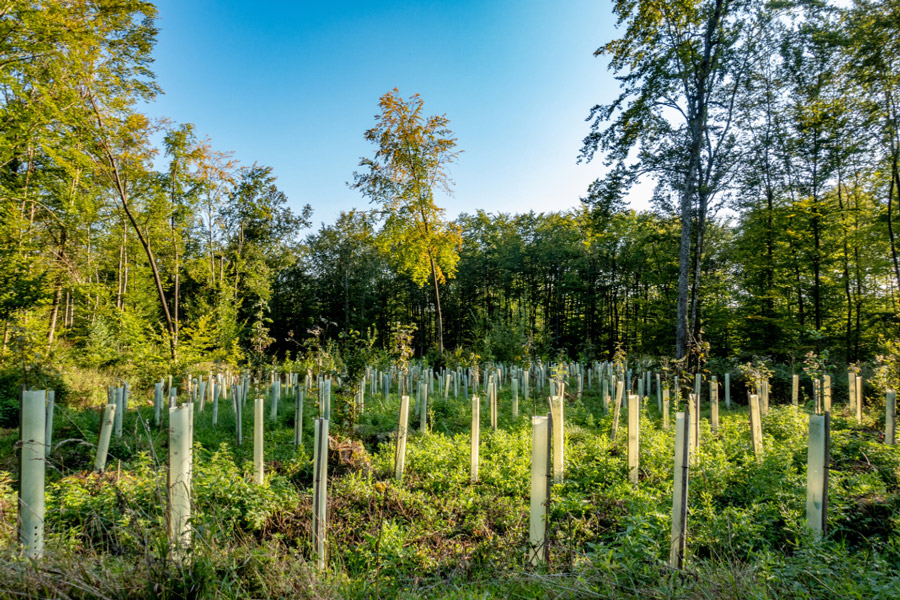
How can we avoid planting forests that are at high risk of succumbing to storms, drought events, heat shocks, flooding, forest fires, new pests – or any combination of these effects – under future climate conditions? This is a key question faced by foresters and restoration managers across Europe.
The lesson from nature is clear: diversity is essential. The establishment of robust and resilient seed sources for a wide range of tree species should therefore become a priority in afforestation programmes. While this alone will not ensure the long-term stability of new forests, it can be an essential component.
OptFORESTS partners analyse existing trials and seed-source programmes across Europe to provide science-based guidance on how such seed sources can be developed. The results will facilitate the creation of pan-European networks of tree seed sources for a broad array of tree species: an essential infrastructure for planting diverse and resilient forests across the EU.
Forests in a changing climate
The green transition towards sustainable, bio-based economies requires wood products that can replace fossil-fuel-intensive materials such as concrete and steel. These products can be grown in forest ecosystems that also build carbon stocks, provide habitats for diverse species, protect soil, water and nutrient balances, safeguard cultural values, and support human physical and mental health and well-being.
This wide range of environmental services explains why the establishment of new forests is a key element of climate mitigation and adaptation actions across Europe. The need is for healthy, productive and biodiverse forests that remain stable, productive and attractive to people for centuries. Unfortunately, the health of trees and forests is increasingly challenged by multiple global changes.
Climate change and the globalisation of trade in wood products have already exposed European forests to new pests, pathogens and severe climatic events—a combination of challenges that is likely to intensify in the future. Decision-makers and forest managers therefore face a serious question: how do we avoid forests planted today succumbing to future storms, drought events, heat shocks, flooding, forest fires or new pests? If this happens, the substantial societal investment in new forests may be in vain.
Reducing the risk of such collapse is a key objective of OptFORESTS. This is achieved through the development of forest reproductive material that can form the basis of robust and resilient forests for the future: trees that are healthy and vigorous when planted today, but can also thrive under future climate conditions while retaining adaptability to unforeseen events.
Fortunately, most forest tree species harbour extensive genetic diversity in their ability to grow under a wide range of environmental conditions. OptFORESTS therefore addresses future uncertainty by developing solutions based on the use and protection of this diversity.
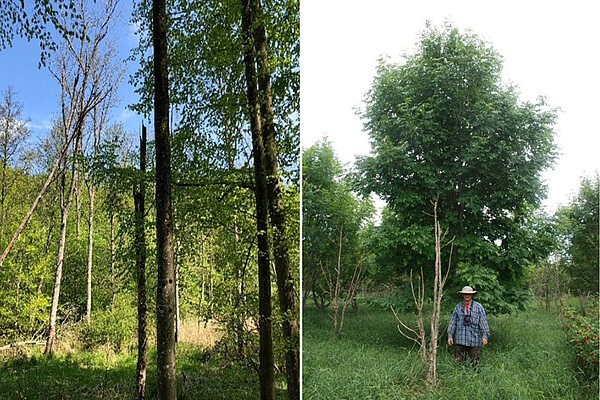
Ash trees across Europe are severely affected by ash dieback caused by the pathogen Hymenoscyphus fraxineus. However, a small number of trees show high levels of natural tolerance. OptFORESTS investigates how this genetic diversity can be harnessed to develop seed sources with improved tolerance, while maintaining strong adaptive potential to future threats.
Low-input breeding for resilient forests
Today, many large forest tree breeding programmes focus on optimising improvement in economically important plantation species. Provision of valuable products are important, but this is not the main focus of OptFORESTS. Instead, the project targets a diversity of species that differ in economic importance but are crucial for ecological values and for reducing overall risk.
OptFORESTS partners generate new insights by learning from existing programmes and by studying fitness and adaptive potential across many species, countries and ecological contexts. The strategy is to design innovative solutions for productive and resilient forests based on the wise management and deployment of forests’ inherent genetic diversity.
The risk of failure is reduced by using multiple species. If one species falls victim to a new pest or an extreme climatic event, other species can maintain forest cover and continue to produce desired wood products. However, species-rich planting programmes require high-quality seed sources for many species, suited to different ecological regions, management objectives and socio-economic contexts.
The focus on many species calls for cost-effective approaches. The project team therefore aims to design low-input solutions that are feasible, flexible and capable of accommodating the need to establish new, diverse forests with many tree species.
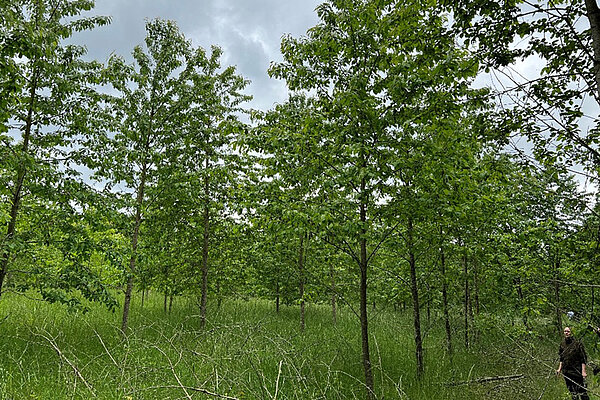
One of the wild cherry (Prunus avium) plantings studied in OptFORESTS. These trees are offspring of healthy parent trees growing at several wind-exposed sites in western Denmark. Genetic diversity remains high despite selection for good stem form. Prunus avium is one of 23 native woody species for which the Danish Nature Agency has developed seed sources using low-input, high-diversity approaches. Such seed sources form a critical infrastructure for future tree plantings.
Dialogue between tree breeders, forest nurseries, silviculturists and stakeholders is essential to co-create feasible and socially acceptable solutions, while optimising efforts to ensure healthy and stable forest development. Fostering this dialogue is an integral part of OptFORESTS and an important activity in the year ahead.
This article was originally written by Erik Dahl Kjær (University of Copenhagen), who leads the OptFORESTS WP5, “Breeding with and for high genetic diversity’