The morning sessions highlighted the central role of biodiversity at multiple levels (genetic, species and ecosystem) in supporting forest health, ecosystem services and the European bioeconomy. Presentations emphasised the importance of conserving forest and tree genetic resources (FGR) as a key lever for adapting forests to climate change and ensuring long-term resilience.
Several contributions highlighted ongoing efforts across Europe. For example, the characterisation of Genetic Conservation Units (GCUs) and their integration into the EUFGIS database (www.eufgis.org) were presented as a cornerstone of in situ conservation of forest genetic diversity, with more than 3,500 units established across 37 countries, while also fostering ambitious national initiatives (e.g. in Spain). Additional initiatives included the development of a network of 29 multi-species common gardens (comparative experiments) across Europe, as well as efforts to explore the untapped genetic resources of wild relatives of fruit trees, particularly in southern and eastern regions. Together, these initiatives aim to improve the characterisation, monitoring and management of forest and tree genetic resources at both national and European scales.
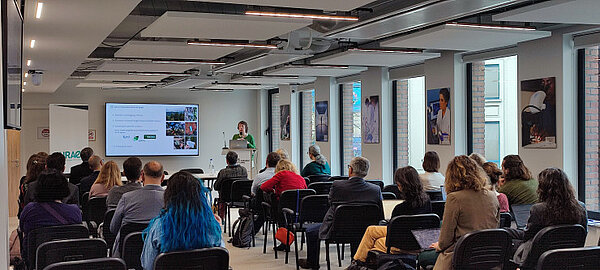
The role of the forest nursery sector was also discussed in the context of the European Green Deal. With the ambition to plant 3 billion additional trees by 2030, nurseries are expected to play a critical role, although they face significant challenges related to seed supply, production risks and regulatory constraints. Strengthening coordination, improving access to forest reproductive material, planning in advance, and developing a common European strategy were identified as key priorities.
The morning sessions were wrapped-up in a round table, where participants discussed the strengths and weaknesses of current policies, as well as new research avenues (namely, the need to study the foundations and effects of biological interactions, the role of genetic mixtures at the intra- and inter-specific levels, the extension of the use of high-throughput technologies to monitor biodiversity, the establishment of sustainable mechanisms to foster biodiversity resilience at all levels on the long term).
The afternoon session focused on adapting Europe’s forests to global change, with a strong emphasis on ecosystem-based approaches and insights provided from multiple angles, from forest management to insurance and certification. In particular, the role of ecosystem-based adaptation (EbA) to enhance social-ecological resilience was highlighted. In case studies implementing EbA, results showed a strong potential to reduce vulnerability to climate risks while maintaining ecosystem services and supporting local communities. Examples include increasing structural and species diversity in forest landscapes (e.g., by planting hedges around rows of monospecific commercial tree plantations), promoting mixed stands, and designing multifunctional systems that combine production with biodiversity conservation.
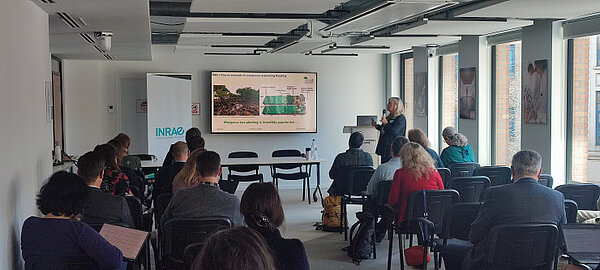
Discussions also highlighted the importance of aligning forest management with future climate conditions, notably through the selection of appropriate species and provenances (“the right tree in the right place for the right purpose”), and through the use of ecological knowledge to guide decision-making. Contributions further addressed the role of governance, policy frameworks and market-based mechanisms in supporting adaptation, as well as the need to better integrate scientific knowledge into practical forest management.
Overall, the event underscored the need for stronger integration between science, policy and practice, as well as enhanced collaboration across sectors and countries. Promoting genetic diversity, facilitating the exchange of forest reproductive material, developing pan European research infrastructure and databases and supporting stakeholders in decision-making will be essential to ensure resilient forests in the face of global change.