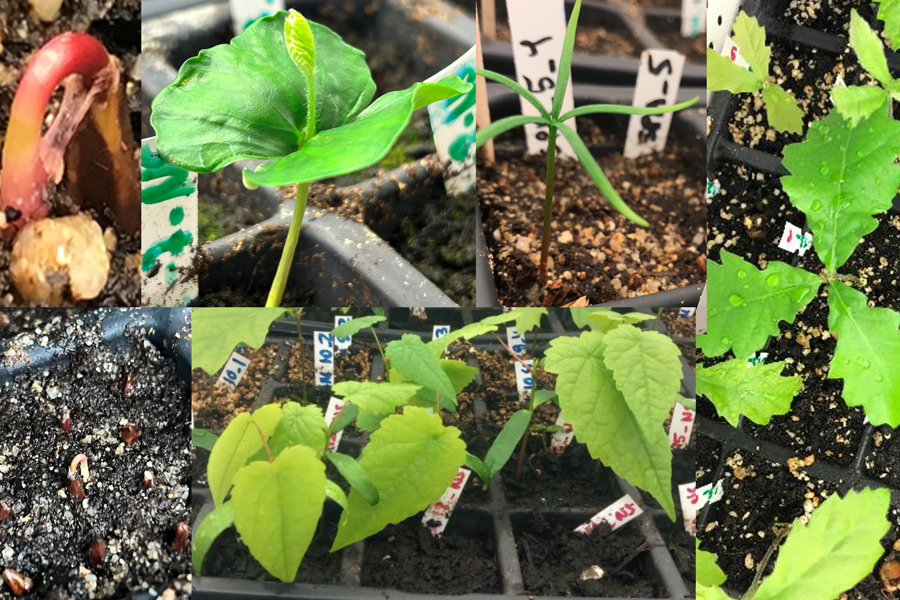
Today, forests face unprecedented climate change. To keep pace with rapidly changing climate conditions, trees must adjust their distribution ranges. Whether forests renew naturally or through human-assisted planting, their future hinges on one biological event: the capacity of seeds to germinate in changing environments. Germination represents the first direct encounter between a seed and its environment. It determines the contribution of seedlings to the next generation. Yet, not all seeds would germinate similarly under climate change.
Different seeds, different challenges
Seeds are often classified along a gradient of desiccation sensitivity:
- Orthodox seeds tolerate drying and can be stored for long periods (e.g. Abies alba, Pinus nigra, Pinus sylvestries, Prunus avium, Tilia cordata etc)
- Recalcitrant seeds are highly sensitive to drying and cannot be stored, making them vulnerable to heat and moisture stress (e. g. Quercus spp, Castanea).
Many orthodox seeds are also dormant (e.g. Abies alba, Tilia cordata, Prunus avium), which require specific environmental cues—often early spring humid and mild conditions—to break dormancy. As climates warm and seasons shorten, these cues may no longer be reliably met. Recalcitrant seeds risk desiccation and heat stress in autumn and spring. Furthermore, recalcitrance and dormancy can co-exist as occurs with Fagus sylvatica and Acer pseudoplatanus seeds, increasing the potential risks to successful germination under warming climates. On top of this, tree species often show local adaptation, meaning that seeds from different origins may have distinct climate sensitivities.
Why do we know so little about tree germination?
Despite its importance, germination has long been an understudied stage in forest ecology. The reasons are largely logistical:
- Seed production varies year to year and across species ranges (i.e. mast years).
- Collecting seeds at continental scales is difficult.
- Recalcitrant seeds cannot be stored and must be used immediately after collection.
- Germination experiments are time-consuming and require controlled conditions.
As a result, our understanding of how European tree species will regenerate in a warmer climate has remained limited until now.
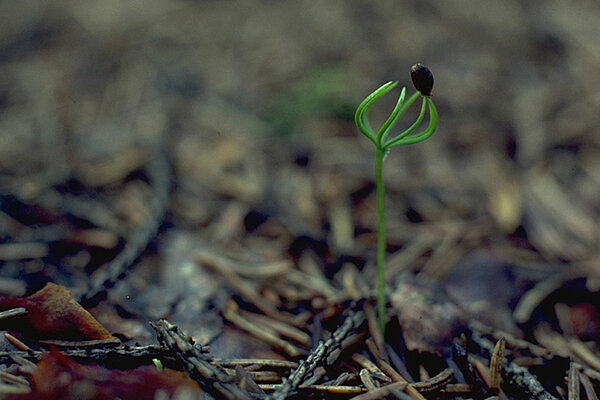
How OptFORESTS is advancing tree germination research in Europe?
Between 2022 and 2025, OptFORESTS partners have carried out an unprecedented effort in collecting seeds across species’ entire ranges in Europe. These seeds have been used in controlled germination experiments designed to test:
- How populations differ in warm-cued responses
- How recalcitrant and orthodox seeds respond to temperature
- How dormancy release affects germination and seedlings' fitness
- What thresholds are required for seeds to germinate in changing climates
- What the germination and regeneration niches of European tree species are
The first series of experiments focused on several populations of Abies alba, Acer pseudoplatanus, Fagus sylvatica, Quercus pubescens, Quercus petraea. New experiments are planned for Pinus nigra, Prunus avium, and Tilia cordata.
As a proof of concept, the project also explored non-invasive techniques to identify seed origin and predict the germination of silver fir. These methods could revolutionise the study of physiological processes during dormancy release and open new perspectives for long-term seed storage.
What comes next?
The experiments have been a major success, with more than 14,000 individual seeds germinated so far. Once analysed, these data will shed light on the population and species-level adaptation strategies in germination, as well as the seeds’ capacity to adjust through plasticity in the short-time.
The knowledge generated will be essential to guide forest management, conservation strategies, planting and reforestation efforts across Europe and ultimately helping forests renewal in a rapidly changing world.
This article was originally written by Marta Benito Garzón (UMR Biogeco – Biodiversité Gènes et Communautés, INRAE), who contributes to OptFORESTS WP3, “Next-generation common garden trials to promote biodiversity and climate change adaptation.”