For decades, researchers have planted trees from different origins side by side in "common gardens" to compare how they perform. Most of these trials, however, focused on commercially important species such as beech, oaks and pines, and measured growth rather than climate adaptation and resilience. Few included stressful test environments. As climate change reshapes Europe's forests, how can common gardens tell us which trees will cope with tomorrow's conditions?
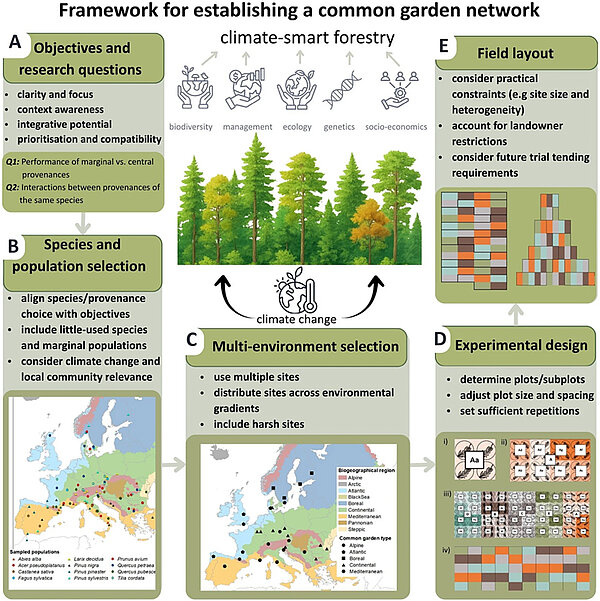
In our research (Westergren et al., 2026, Rethinking common gardens for forest tree species in the face of climate change), we propose a step-by-step framework for a new generation of common gardens. We then applied it to the MOSAIC common garden network, established by OptFORESTS, which includes:
- 29 common gardens in 17 European countries and seven biogeographic regions, from Boreal to Mediterranean.
- 12 forest tree species, selected through stakeholder consultation, and 90 provenances.
- Populations from both the core and the margins of each species' range, tested at sites that include suboptimal conditions near or beyond the species' current climatic limits.
To choose the layout, we simulated three experimental designs and ran power analyses to check that the design could deliver statistically robust results.
What did the study find?
A small plot of land can still produce reliable results, as long as the trees are arranged cleverly. Each of our gardens holds 1,600 young trees from five species. Every species has its own patch, and within each patch we plant small groups of four trees grown from seed collected in different places. Each species comes from eight places: four from typical conditions at the heart of its range, and four from marginal ones, mainly at the edges of its range, where conditions are tougher. This pattern is repeated ten times at every site to account for natural variation within the site. Scots pine and sessile oak are planted across the whole network, although at two sites in Finland a close relative, pedunculate oak, is used instead for legal reasons.
Because of this arrangement, many trees grow right next to trees of the same species but from a different origin. This lets us see how trees of different origins perform when grown together. Other networks, such as TREEDIVNET, study mixtures of different species, but not mixtures within a single species. The design is also sensitive enough to spot real differences. One garden can reveal moderate differences between trees of different origins, and combining just six gardens can pick up even small ones.
We also deliberately planted some gardens in tough places, near or beyond the limits of the conditions a species normally grows in. For Scots pine, these sites are warmer and drier. For sessile oak, colder and wetter sites were also included. These sites have to be chosen carefully, but they tell us things that comfortable sites cannot. Even if every tree at a site dies, that shows us where a species or population reaches its limits. Tough conditions can also reveal hidden genetic differences between trees that only show up in such environments and may matter for adapting to climate change.
Why does this matter?
Policymakers in Europe and internationally, through frameworks such as the Sustainable Development Goals, are calling for forests that are more diverse and more resilient to climate change. Meeting this objective requires a thorough understanding of how species, populations and their mixtures will respond to changing climatic conditions.
Because the sensitivity of trees to climate varies across life stages, with seedlings and mature trees responding differently, long-term experiments are needed that follow trees over many years and apply consistent monitoring across all sites. Accordingly, while each MOSAIC partner is responsible for managing its own gardens, the network is coordinated through a memorandum of understanding, common monitoring protocols, and a shared central database.
The key take-home messages are:
- Traditional common gardens have focused on commercial species and growth traits rather than climate resilience.
- New-generation networks should include understudied species, marginal populations and harsh sites.
- The MOSAIC network tests 12 species and 90 provenances in 29 gardens across Europe.
- A compact split-plot design gives statistically robust results while remaining feasible in terms of land and cost.
- The trees planted today will tell us which forests can thrive tomorrow.
The study was published in Annals of Forest Science. You can read it in full here.
Full reference
Westergren, M., Streit, K., van Loo, M., Alía, R., González-Martínez, S. C., Benito-Garzón, M., Lario Leza, F. J., Climent Maldonado, J. M., Mihai, G., & Myking, T. 2026. Rethinking common gardens for forest tree species in the face of climate change. Annals of Forest Science, 83, 40.