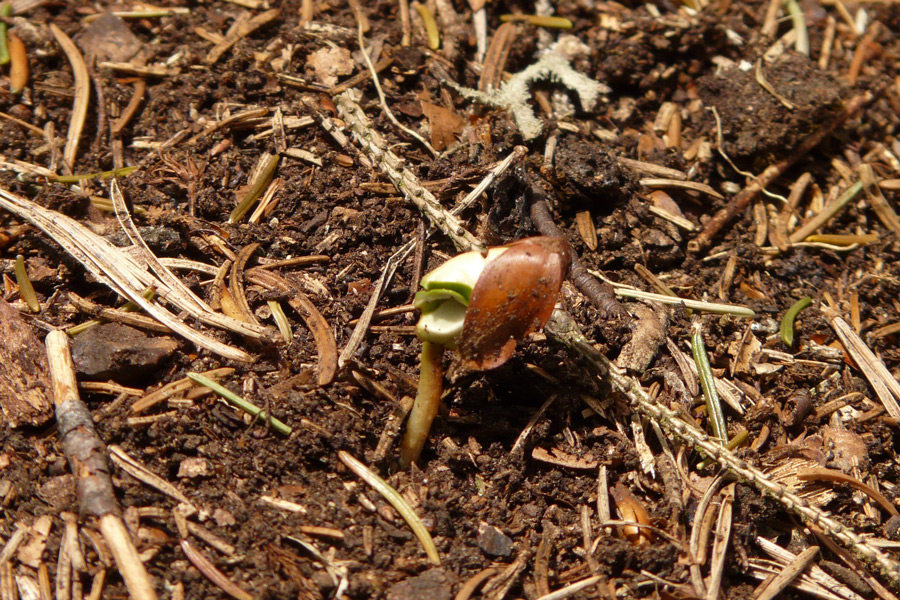
Germination is the moment a tree first meets its environment, and what happens then can affect how well the seedling grows and whether it survives. These first steps are a critical bottleneck for forest regeneration and are particularly sensitive to climate change. Yet we still know surprisingly little about how seeds and seedlings respond to climate, or how this differs between populations. That leaves an open question: how can the right seeds be chosen for tomorrow’s forests?
In a new OptFORESTS study, OptGERM: a comprehensive database of within and among species germination and early seedling development for six European tree species (Benito Garzón et al., 2026), researchers present an open database of germination and early seedling development, which includes:
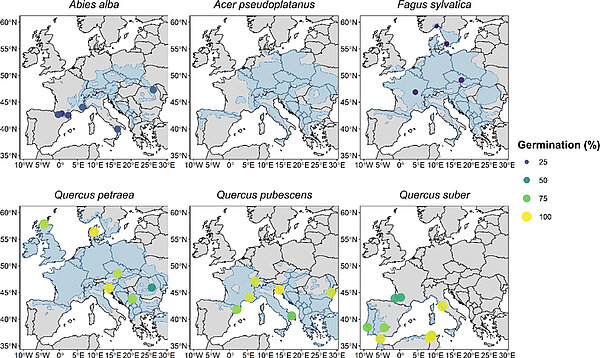
- 15,774 seeds from 43 populations of six species: silver fir, sycamore, European beech, sessile oak, pubescent oak and cork oak.
- Seeds collected between 2021 and 2024 from 8 to 20 mother trees per population, covering each species’ distribution range and including both core and marginal populations.
- Data on seed traits, germination, first leaf emergence and early seedling growth.
To test the effect of warming, the research team sowed the seeds in climate chambers at 15, 20 and 25 °C, simulating an increase of at least 5 °C compared with conditions at each seed’s origin.
What did the study find?
All the traits measured varied across populations, species and sowing temperatures. The researchers monitored germination and first leaf emergence three days a week for five months. One to four months after the first leaf appeared, depending on the species, they measured the seedlings’ stem height and diameter, biomass and leaf pigments. For silver fir, sycamore and beech, whose seeds are dormant, half of each seed lot received a cold (4 °C), moist stratification treatment for three to six weeks, while the other half was sown directly as a control.
Studies already using OptGERM data show that cork oak populations from warmer, drier environments have higher germination rates. Their seedlings also have a greater capacity to take up water and carbon, which is essential for surviving their first summer. In silver fir, sycamore and beech, stratification improved seedling fitness depending on population origin. The data can help identify populations at risk of reduced germination when their dormancy-breaking requirements are not met.
Germination timing also matters. Germinating late may help seedlings avoid late frosts, but it could increase their vulnerability to early-season droughts, a growing concern in several European regions. OptGERM allows a detailed analysis of how warming affects germination timing and early phenology. However, the authors note that the data reflect responses under experimental warming only, with optimal water availability and relatively low light for light-demanding species such as oaks, so results may differ under natural conditions.
Why does this matter?
Assisted gene flow and assisted regeneration programmes have historically relied mainly on how adult trees respond to climate. OptGERM covers the earliest life stages. Its data can inform models that forecast how species and populations will respond to climate change, helping to identify the most suitable regions and populations for regeneration and restoration.
The OptGERM seed lots that were monitored in nurseries are now planted in common gardens across Europe as part of the OptFORESTS project. This gives researchers a unique opportunity to track how traits relate to each other throughout the trees’ life cycle.
The key take-home messages are:
- The earliest life stages of trees are critical for forest regeneration, but their sensitivity to climate is poorly understood.
- OptGERM records the germination and early development of 15,774 seeds from 43 populations of six tree species under experimental warming.
- Studies using OptGERM show that population origin influences how seeds and seedlings respond.
- The open database can inform assisted gene flow, assisted regeneration and models of species’ responses to climate change.
- The same seed lots are now planted in OptFORESTS common gardens, so they can be followed throughout their life cycle.
The study was published in Annals of Forest Science, and the dataset is openly available on Zenodo. You can read it in full here.
Full reference
Benito Garzón, M., Agro, M., Vicente, E., Carme, M., Dencausse, B., Kohler, A., Alexandru, A.-M., Avanzi, C., Bagnoli, F., Belovarska, M., Dovč, N., Fady, B., González-Martínez, S. C., Hansen, J. K., Kravanja, M., Kroon, J., Lario, F., Marchi, M., Mihai, G., Musch, B., Myking, T., Ødegaard, J., Piotti, A., Pringarbe, M., Rellstab, C., Sim, T., Skoberne, G., Stoica, E., Stejskal, J., Streit, K., Tollefsrud, M. M., Torano, A., Uhl, E., Van Loo, M., & Westergren, M. 2026. OptGERM: a comprehensive database of within and among species germination and early seedling development for six European tree species. Annals of Forest Science, 83, 47.