A newly published review by Lefèvre (2026) invites foresters and researchers to rethink how we understand adaptation in trees, moving away from a static view of populations as simply "adapted" or "not adapted", towards a dynamic, process-based approach.
The paper argues that treating adaptation only as a finished state can be misleading. It risks suggesting that well-adapted populations have exhausted their genetic variation, and that adaptation always takes many generations to occur. For long-lived organisms such as trees, which respond continuously to selection while retaining high levels of adaptive trait variation, that assumption does not hold.
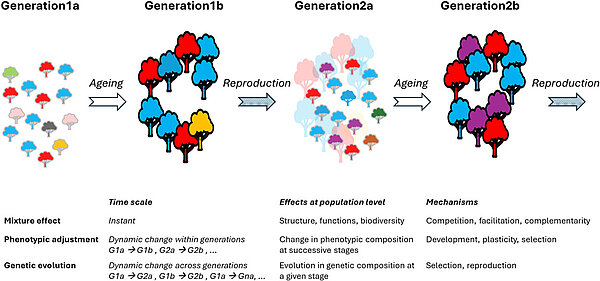
Building on the genes-traits-fitness mapping framework, the review examines how selection acts on different types of traits, how trait variation and coordination reflect both biological constraints and responses to selection, and how these relationships shift across space, time, environmental conditions, and developmental stages. A dedicated section considers how forestry interventions themselves influence trait variation and selection.
The conclusion makes the case for integrating selection into management thinking as a dynamic and, in part, manageable process, with direct implications for the sustainable use and conservation of forest genetic resources under global change.
While not a direct output of OptFORESTS, the review speaks closely to the project's work on the adaptive capacity of European forests and offers a valuable reference for anyone working on forest genetics and sustainable forest management.
Read the full paper: Lefèvre, F. (2026). Integrating intraspecific trait variation and spatiotemporal variability of selection as levers of action in forest management. Comptes Rendus. Biologies, 349, 171-187. https://doi.org/10.5802/crbiol.200